Translate

Showing posts with label family. Show all posts

Wednesday, 27 February 2013

THE REAL POWER OF ROMANIA

We went to Sibiu this weekend.
The trip was primarily to meet members of Sibiu Ballet Company, who would like to do something to help support the Special Needs Centre that we work at, or even to do a performance to raise some money for them. They are really lovely people and we had a great time with them.
While we were there though we also had a little time to relax.
When we have had city breaks in the past, relaxation during the day happened by finding cafes frequented by the locals, not the tourist ones, and sitting in them and just to watch the world go by.
That's exactly what we did in Sibiu. We found a cafe overlooking the beautiful main town square, went in and sat down at a table in the window. We drank great coffee, chatted, and watched the world go by as people went about their business in the square in front of us.
As usual we talked about the people we could see and speculated occasionally about what they might be doing or where they might be going.
After a few minutes a pair of street sweepers came into view, a middle-aged woman and an older man. They were both dressed in dark coloured waterproof jackets and trousers with high visibility bands around the arms and legs. The woman was brushing hard at the cobbles, really having to make an effort to get the dirt and cigarette butts out form the cracks between them. All she had to work with was a Besom Broom, you know like the famous 'witches broomstick', which seemed to make the work twice as hard as it needed to be, but she just kept on going without resting, really working the broom into the cracks between the cobbles.
Road sweepers throughout Romania use these brooms, but most are sweeping tarmac or smooth paving, not ancient cobbles.
As I watched I thought about the road sweeping machines that they use in other 'better developed' cities in the world and wished that this poor lady could have one. Then I realised though, that if the city of Sibiu did have one, she would probably be out of a job and it would be the man she was 'working' with  who would probably be driving the machine around the square and making a nuisance of himself among the many pedestrians.
Piata Mare, Sibiu
His task this day seemed at first to be one of just leaning on a floor brush next to a wheelie bin, and watching as the woman swept and swept at the rough paving, occasionally making a comment or pointing at something she had missed. He stood watching her for about ten minutes, then suddenly he leaped into action. He took a shovel from his wheelie bin, swept the pile of dog-ends and litter that the lady had made up into the shovel and then almost ceremonially emptied the shovel into the wheelie bin before tapping it on the side and then throwing it and the brush inside. He then strode off, at pace, pushing the wheelie bin towards the other side of the square.
I craned my neck around to look out of the corner of the window and I could see that another lady was on the other side of the square brushing just as vigorously at the cobbles over there. Once the man arrived next to her, he took his brush from the bin, leaned on it and stood watching her, just as he had been doing when I first saw him.
Another lady, completely different place, same hard
work, similar broom.
I looked back at the first woman and she was still working her broom furiously, making neat piles of rubbish, and I suspected that she might be trying to get far enough ahead of her task so that the man didn't have any time just to stand and watch whenever he returned.
As she brushed I saw a young man walk past her and then casually discard a cigarette end onto the paving where she had already brushed, not even glancing at the woman, or caring that she was working so hard.
It was then that it struck me that this really is a never-ending task for these ladies, and a task that would never be finished.
As a story I think this is also indicative of Romanian life generally. there are so many fit and healthy old ladies in our village, in their 80's and 90's they always greet us with a cheeky grin, a happy hello, and often a risque comment too! They are so full of life. The women are on their own, they are all widows, there are no men of similar ages.
It was Ali who pointed it out, and stressed that it is no surprise. After all it is usually the women who do all of the hard physical work, spending all day bent over, planting or picking or weeding in the fields, and then return home at the end of a long hard day to cook, wash, clean and raise their children.
They live a life that has kept them a lot fitter.
The men tend to supervise, just as the male road sweeper was doing.
Either that or they spend their time in local bars smoking, drinking coffee, beer or Tuica 'doing business,' or just talking about what needs to be done at any particular time of year. They might even discuss the big issues of the day, and of course, all will have an answer to them that no-one else has thought of.
Even the younger women who work long hours in bars, cafes or offices in the City have to return home to do the cooking, cleaning, etc., so modern day life hasn't changed things greatly.

So it's no wonder that it is the ladies who have the longevity, they have been kept fit all their lives by the amount of work they have to do, whilst the men live  a far less healthy existence.
It is the women of Romania who are the power houses, who break their backs to try and ensure that their children, and their men, are fed, clean and presentable, and women have lived this lifestyle here for hundreds if not thousands of years.
The same is true in other less-developed parts of the world too, and I know that I am generalising and that this isn't true of all men and women, but from my observations of everyday Romanian life, it is the way the great majority of women live.
It's the woman who are the real power.

Steve

Wednesday, 19 December 2012

A ROMANIAN VILLAGE ENGLISH CHRISTMAS

The sounds of the single bell tolling and the drum beating emanate from the beautiful small painted church on the hillside, echoing down through the valley and all of the way around the village.
Those simple sounds announce that it is Sunday, December 2nd, the start of Advent, and it is the first day of a traditional Romanian Orthodox Christmas. For those who still follow the old traditions, and there are many in the village who do, it marks the start of the Advent Fast, which means that no animal products are eaten until the Fast is broken, on the evening of Christmas Eve. No meat, no fish, no poultry, no milk, no eggs, which can't be easy in a society whose basic diet is entirely made up of these items, and who's favourite vegetable is Pork!
The bell and drums will sound each day during Advent, just as they do on every important day in the religious calendar, and they will count each day away as the four weeks progress.
On December 6th, St Nicholas Day, decorations go up, small token gifts are given to those children who have been 'good' throughout the year, and small decorated sticks are given to those who have not been so good. The tradition of the sticks is that those 'not so good' children are symbolically beaten with them to remind them that they still have three weeks left to be good, and maybe still redeem themselves enough to have presents delivered by Mos Craciun (Father Christmas) early on Christmas morning.
The evening of Christmas Eve then is when the traditional Christmas family meal is eaten here in Romania, even for the many who no longer follow the tradition of fasting for four weeks beforehand.
These weeks are also when the ceremony of 'preparing the pig' takes place. It isn't called that at all, but it is the way Romanians talk about it, and even those who live in the City refer to this special family occasion with fondness. Unfortunately that also means that this is the time when we hear the sounds of pigs being slaughtered around the village. It's not nice, but it is over very quickly, and it does help us to understand the reality of things, particularly for those of us who have been used to buying meat in shrink-wrapped plastic from supermarkets and have therefore been able to shut out this essential, but ignored part of the process of getting it there. It's part of 'living a 'real' life', which is often how we describe our lives here. Once the animal is gone it is used to make sausages, it is smoked, parts are minced to make Mici, the skin and fat are dried to make Slănină (which is basically just pig fat eaten as part of the basic diet), and great lumps of meat are smoked and reserved for that ever so important Christmas Eve family meal, and the whole family gather together after the pig is killed to help to prepare each item.
It is wonderful to see and to be a small part of it, as Christmas comes slowly here, and the build up to it is such a busy time. We have been invited a few times to join in, but as yet we haven't been able to, for lots of reasons, but one day we will, and I know we will enjoy it.
It will be no worse than going to a barbecue in The Lebanon, which I have also done, when the first thing that happened was the delivery of two live sheep on the back of a pick-up truck.......first, select your sheep, .......second. slaughter it, ..........like I said, it's real life, and it was a great and very very tasty barbecue.
We try our hardest to live our daily lives as our Romanian friends and neighbour's do throughout the year, only occasionally reverting to type and cooking in a traditional English manner (in other words...curry!). The only exception to this being tea, which we just can't give up. We simply can't get good English tea here, so when we do receive the odd packet from our visitors or friends it is a real treat.
However, Christmas is different. Christmas is something that we want to do in the way we have known it for so many years, but it isn't simply a matter of going to the supermarket to buy all we need as we would have done when we lived in England. There are so many more things that we simply can't get here, and it is at this time of year that you realise it most.
So, just like our neighbour's are doing, we have been preparing for it for weeks. We may not have been doing the same things, but in our own way we have been just as busy as they have, and we have gathered everything we need to make our little Christmas perfectly English, but there is so much of it that we have to make for ourselves.
Our first essential is to have logs cut and ready for the fires to keep us warm, all done, and it is very 'unRomanian' of us to be this ready as we often hear the sound of logs being chopped around the village on Christmas day itself.
Our tree is up in our lounge, decorated and looking beautiful. Unfortunately we couldn't afford to buy a real one this year, nor did we have time to go into the forest and fell one, so it's our old artificial tree, but it looks beautiful all the same.
We actually made  a pretty good job of our traditional Christmas last year, without really  trying, but this year we determined ourselves to do it better, much much better.
We have our turkey, in the freezer and waiting for the day, we have potatoes, which we will cook in pork fat to be perfect, golden brown and crispy on the day. We have Carrots and Parsnips, as well as Brussels Sprouts, sadly not home-grown, but next year they will be. 
We can make our own gravy, we can make our own Yorkshire Puddings if we want them (and the other 'alf does make a particularly nice job of them!).
We have a still-in-date unopened jar of Cranberry Sauce and we have a few Christmas Crackers that we saved from last year, so we can wear the silly hats, enjoy the little tokens, read and laugh at the silly jokes and the not-so-wise sayings from within as we eat.
So what else could we possibly want?
It's when you ask yourself that question that you realise that it isn't actually the 'big' items that make the perfect Christmas at all, it's the small additions that just finish things off and make them perfect.
Like stuffing!
How could you eat a Christmas Turkey without stuffing? It just wouldn't be right would it?
And chipolatas to be wrapped in bacon? Where would Christmas be without those?
So we''ll just pop out to the shops and get some Paxo shall we? Oops! No!
Now I am sure that there will be many reading this (at least I hope someone else reads it!) who are good cooks and who will say 'Hey making your own stuffing isn't difficult!', and I am sure you are right, but when you have never done it before it is a daunting prospect. 
Just as it was for me when we created our own cottage garden this year to grow our own produce for the first time. Having never, ever, had any interest in gardening whatsoever in my life, it seemed miraculous to me when this rough patch of ground that we had painstakingly fenced off from our dogs and prepared produced, Spring Onions, Lettuce, Potatoes, Red and White Onions, Garlic and Tomatoes in abundance! I have really caught the bug now and I am so looking forward to Spring arriving early so that we can get on with it again, and I am determined to build a Greenhouse from old windows too!
We managed to make stuffing well last year but had trouble getting the ingredients as fine as we would have liked them to be, as a result we had chunky Sage and Onion stuffing. It was very nice but this year we will do better....why?.....well we  bought a meat grinding machine!!!
Having this marvellous tool in the kitchen has opened our eyes to a whole world of new possibilities. It has a sausage pipe, so the first, obviously, was good old-fashioned English Bangers. 
Hooray! sausages WITHOUT garlic!!!
There they are ready and waiting in the freezer. We got a bit carried away though, we have about 100 of them, of all types, plain pork, pork and herb, pork and leek, etc., and as the other 'alf, (she who must be obeyed in all things) isn't really that fond of sausages it means that John and I have an ample supply to keep us going for a while! We have now found good bacon too, unadulterated with garlic, so Pigs in Blankets, Angels on Horseback, whatever you want to call them are simply no problem this year.
Our stuffing's will be finely minced as well, so who needs Paxo anyway?
There will be three on the menu, Sage and Onion, of course, Chestnut, and a sausage meat stuffing.
We have a Christmas Pudding too, two actually, thanks to a good friend. No cream, but we can make custard OK.
We also have six PG Tips tea bags stashed away, so we have good tea on the day too. These are what remain of a box that a volunteer bought with her at the beginning of December, having heard about our plight. We have been fortunate enough over the last few years to host many wonderful volunteers and guests here, but this lady is very very special. The week she stayed with us was a wonderful one, re-awakening us to the real reasons we are here in Romania. We have all become great, lifelong friends, and one day I will write more about her, but at the moment she is too greatly missed, and I know that if I write as we truly feel then there will only be more tears, as there were on the day she left, and have been occasionally when we have spoken since. Suffice it to say that when she arrived, she bought the beginning of our Christmas with her.
We also have some new but already very good friends and family sending us parcels full of goodies to help our Christmas along, and we are looking forward to their arrival with some excitement. They will have the things that we can't really make in them, including more tea bags,   English biscuits (Ginger Nuts and Custard Creams.....what else?), a few little surprises too I should think, and a bottle of Glenfiddich from a very very generous friend.
Having all those sausages, and having found good bacon, also means that next years weekend treats of a homemade Full English Breakfast are no problem! (And here I was earlier, talking boastfully about trying to live life like a local! Oh well, the occasional treat can't hurt can it?)
Christmas Day then is sorted. We have all of the food we need to make our perfect meal, local wine is excellent and very cheap, and we can also top it up with Ţuică
We'll be in English Christmas heaven for the day, and there's bound to be a daft English, Australian, or American movie on Romanian TV that we can sit and watch as it all goes down in the evening.
Last year, for some reason we don't know, we all woke up at 3.30 a.m. on Christmas Day, just like over-excited children. Having nothing else to do we switched the television on to find a film called 'Malcolm' beginning. It's a fairly odd but amusing Australian movie about some unlikely people who commit a robbery, and it was perfect for that day and time. If we could we would have made it part of all our traditional Christmas's from then on.
However, we then have Boxing Day don't we? It is as an essential part of the traditional English Christmas as the day is itself, and it is the day that provides my favourite meal of cold meats, mashed potatoes, and pickles.
So this is an easy day huh? It's just leftovers.
OK yes, we will have the cold turkey, we have a tin of Ham (only in a tin because this year we couldn't afford the complete leg of smoked Romanian ham that were on sale in the market, but maybe next year). Mashed potatoes are obviously no problem either, but pickles??
Now I have already written at length about pickles and the British love of them on Boxing Day in an earlier Blog, 'Creating The Perfect English Christmas',  and about the fact that to have them we have had to make them, throughout the year, so that they mature sufficiently in the jars to be perfect on the day. So we have chutney, pickled onions, simple pickled vegetables, and most important of all Piccalilli!!! Along with bread and butter it will be great.
Anything that is left over after these feasts will be used to make a pie and also some curry to keep us going into the New Year, or will be shared with our dogs, which is the best way by far to recycle.
So, our Christmas is sorted, and has already started, in  a very very Anglo/Romanian manner, and all of the hard preparation will be worth it, I know.
In the 7 days we have remaining before the big day we have been invited to spend time with many of our friends at their houses in the village. 
December the 21st will also be a special day as we have agreed with a number of friends on Twitter to have a Christmas sing-a-long at 12 midday GMT. We will all be singing along to Slade's 'Merry Christmas Everybody' and then posting links to the videos on  twitter for all to see. As long as the Mayans aren't correct and it isn't the end of the world that day, it should be great fun, and it is a fantastic thing to be able to do with people from all over the world. If you fancy joining in after reading this, just get in touch on Twitter using @HolidayinRomani, it really is  a case of 'the more the merrier'.
We have also been 'told' to be at the village bar on Christmas Eve afternoon by the boss there, Gica, to join in with the singing of traditional carols, (and probably singing a few English ones in return), the drinking of hot Tuica, and lots of general merriment. It is a very very good job though that we have ourselves as prepared as we are already, because I know that spending that afternoon at the bar is very likely to render us incapable of doing anything worthwhile during that evening.
Christmas is so much more of a special occasion when it has to be prepared for and planned in this way, and with all the hard work and effort it entails. Also when it will be spent with genuine friends and neighbour's who do actually care about us and our welfare. Although I know we will greatly miss our parents, brothers, sisters, grown up children and grand-children and British friends on the day, I also know that our British Christmas could not be any more special than it will be here, in a tiny village in the heart of Transylvania, Romania. 
It would be fantastic if one day, somehow, someway, we could get them all over here so that they can experience this special time in this very special place for themselves, but we will talk to them all on the day anyway so that we can feel that little bit closer.

What could make Christmas more perfect then than this? Well everyone's dream is to have a white Christmas isn't it? Sorry to boast, but we already have that too! About 8 inches of snow lying and more to come!


So may I wish all of those of you who read this as good a Christmas as we will have, particularly those of you who will be away from family as we are.


Craciun Fericit!!!


Steve, Alison, and John


For more information about why three Brits should be crazy enough to be here in this tiny village in a remote part of Romania (Transylvania) please have a look at our websites www.volunteerromania.co.uk and www.holiday-romania.co.uk or just read some of the earlier Blogs!


Monday, 26 November 2012

CREATING THE PERFECT ENGLISH CHRISTMAS IN ROMANIA 1

We have set about creating the perfect English Christmas for ourselves.
Living in Romania, it isn't always easy to find those 'little' things that you can miss when you are having a special occasion like Christmas lunch.
There is actually very little that we really do miss from the UK on a day to day basis, but definitely good tea bags top that list! (see http://steveromaniablog.blogspot.ro/2012/11/tea-so-close-to-british-expats-heart.html for my ravings on that subject!).
We did look online at some online Expat supermarkets, but by the time everything is shipped to us it works out to be so expensive! Certainly more than we can afford at the moment.
However, Christmas is a special time and we are all used to the way we have celebrated it for so many years with our families back in the UK, and naturally, we would like to do our best to create it.
Last year, without even really trying, we did a pretty good job of it, even if it was only by buying the very last and tiniest Turkey you have ever seen from our local supermarket, because our kitten ate the big one we bought!
So, this year we have decided to prepare for it.
In my family, Christmas dinner consists of turkey, roast potatoes, brussels sprouts, chipolata sausages for pigs in blankets, cabbage or peas, Yorkshire pudding, gravy, sage and onion stuffing, chestnut stuffing, and Cranberry sauce.....I think that's it!
Turkey, we have arranged to buy one freshly killed from a neighbour, but this is Romania, and it may not arrive two days before Christmas as has been arranged, so we have bought a 4kg frozen one, just in case! Not enormous I know, but it's enough for us, and will give us some left overs for the dogs, who we mustn't forget! After all it is their Christmas too!
That's tucked away sleeping in in the freezer in readiness to come out and defrost a couple of days before the big day. If the fresh one does arrive, that will be plucked, cleaned, trimmed and frozen to wait for Easter.
Potatoes, obviously no problem, but substitute pig fat instead of duck or goose fat which we can't get.
Brussels Sprouts, peas, cabbage...got them or can get them when we need them.
Yorkshire pudding...the other 'alf makes a beautiful light Yorkshire pudding from scratch so no problem.
We also have a safe brand new jar of Cranberry sauce which we saved from last year, still 'in date' and stored in a nice cool place in readiness.
That leaves chipolatas (English style mini sausages) for the pigs in blankets. Bacon we can get, even if it is a bit thin (so two rashers around each to make sure), but the sausages, ah now there is another problem. Last year we used Bavarian Beer sausages. They are very nice eaten cold with a beer or three, but they aren't quite English Christmas lunch fare. So, this year we have the meat grinder, sausage attachment, pork shoulder, sage and onion, as well as Leek for a little variety, to make the perfect 'English' sausages.
Sage and onion and chestnut stuffing is also not a problem. We made stuffing last year but without a mincer it was a little coarse. This year though we have the right tools for the job so I am confident that we will make an even better job of our stuffings this time.
We even have a Christmas pudding in the pantry which was a 'spare' from last year. We can also make a really good custard from scratch if we want to, but also by buying a local pudding mix and making it a little thinner than instructed. I know it sounds odd, but it works well.
Cream, we can't get, but we won't miss it, and as for brandy butter, well I've never really been a fan anyway.
So that's Christmas Day sorted out without too much hassle (as long as I can actually make the sausages that is! I will report back later on that endeavour)
So, now for Boxing Day. The Boxing Day meal has always been my favourite Christmas meal, since I was a child. In  my family it means the cold turkey left over from the day before, with some slices of good ham, served with mashed potatoes and cold pickles with bread and butter.
Meat, potatoes, bread, butter........all no problem, but pickles, ah pickles, there is another question.
I know that in so many parts of the world 'pickles' just means large green pickled Dills , but English pickles come in so many varieties and with so many different subtle flavours. These are the highlight of the proper English Boxing Day meal, and we can't buy them here in Romania. So? We're going to make them! From scratch!
We have already made some very good chutneys, which are just waiting in their jars to be opened when we need them, but we still need pickled onions, and of course Picalilli!
No Boxing Day meal is complete without the colour, flavour and crispiness of a good Picalilli!
For the uninitiated reader, Picalilli is a preserve with a variety of almost raw fresh vegetables pickled in a mixture of mustard and vinegar.
May not sound good, but believe me it tastes delicious!
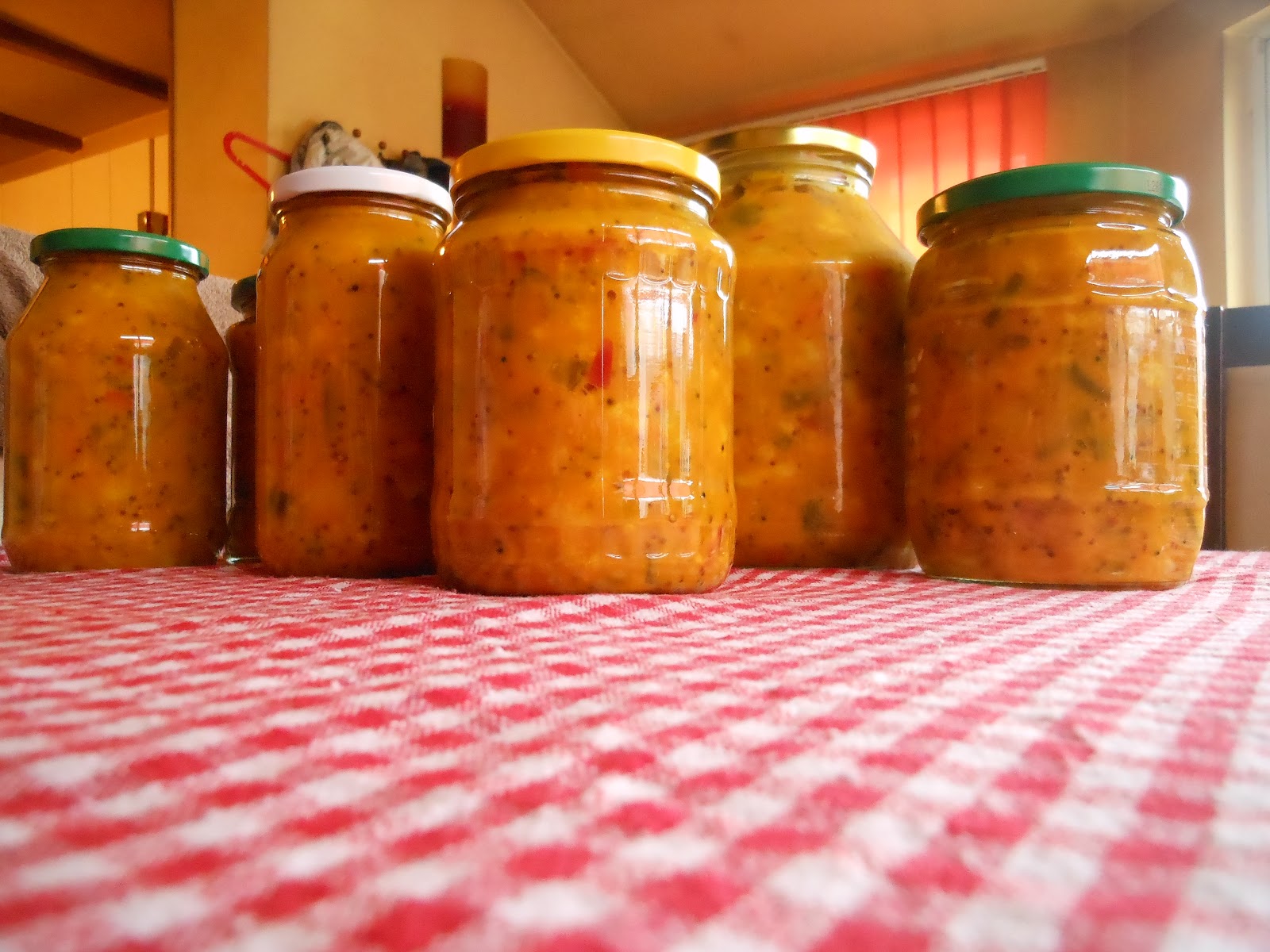
So that has been today's task. Making Picalilli so that it has exactly four weeks to mature in the jars before we open at Christmas, and have some for afterwards too.
First, find your recipe.

I love the worldwide interweb.......here's the recipe, thank you to The Cottage Smallholder http://www.cottagesmallholder.com/christmas-piccalilli-recipe-5658/

OK so that's it is it? You find a recipe, follow it, and tell us how wonderful you are? 
Well yes, I am wonderful, and I also know that my best feature is my modesty, but it is never just a simple matter of 'following the recipe' here in Romania. You have to adapt to use the ingredients that you can get instead of the ones that you can't.

Recipe ingredients;

50g of calabrese florets (broccoli)
250g of green tomatoes (or hard red ones) chopped
300g of cucumbers sliced lengthwise and then sliced into half centimetre half moons
250g of French beans topped and tailed and chopped in half (if you are making this in summer – use your own fresh runner beans)
225g of courgettes chopped
1500g of cauliflower florets
320g of carrots chopped

1 head of celery (destring and slice)
2 red Romano peppers (deseed and chop into 3 cm lengths)
300g of small pickling or baby onions or shallots (skinned and cut in half if they are chunky
100g of salt


Of these we had to use slightly soft large red tomatoes, so they weren't blanched, only chopped and added to the final hot mixture before bottling.
No courgettes either so we used a 'local' alternative called 'Dovleci', (but they are still small white marrows)
The vegetables, all chopped, and soaked in salt water
overnight
No fresh Runner Beans, so we added in frozen Green Beans.
The vegetables were all chopped, (which only took and hour and a half, this is not a 'quick' job!) and then left overnight in salted water.

This morning the real task started. 
Those same vegetables after blanching for two minutes
and draining
The vegetables had to be drained and rinsed and then blanched for two minutes in boiling water, before being immediately rinsed in cold water to stop them going soft. As I had to do this in very small batches in a sieve it seemed to take ages but when I had finished, all of the fresh vegetables in the strainer looked delicious.


Next the pickling mixture. The recipe asks for;

375g of light soft brown sugar
1.5 litres of cider vinegar
80g of mustard powder
1 tsp of celery salt
2 teaspoons of mustard seeds
3 tablespoons of turmeric powder

120g of plain flour

The initial 'dry' paste mix


We had the forethought to bring many Indian spices with us when we moved here from England, as we do love our Curries made from scratch, so Turmeric we have.
Last year, all we could get was mustard powder, this year we couldn't see any! So, thinks, what can we use?
The final 'smooth' paste mix before adding to the
vinegar and sugar mix
There, amongst, the many different mustards they had on the shelves was a special offer on French Whole Grain Mustard in jars, as well as a special offer on good old fashioned strong English Mustard during a special 'English Food' promotion at another supermarket. That'll do! We decided and bought two jars of each (We like English Mustard anyway in ham sandwiches)
Celery salt? Huh! Ask a Romanian shopkeeper if they have Celery Salt....
"You mean salt?......made from celery?.......Mad English people.....go away!!!) 
OK, we can do without, we decided retreating sheepishly.

Starting to add the vegetables to the
pickling mixture

So here we go with the pickling mixture.
In went the flour, mustard seeds, turmeric, a teaspoon of ordinary salt, followed by the contents of one jar of whole-grain mustard. The mustard that comes in the jars is already a paste so it was easy to start mixing the ingredients in to a dry paste, by adding the second jar this became a nice smooth paste and two dinner spoons full of English mustard finished it perfectly, as well as adding a little 'tartness' to the flavour, without the need for adding vinegar. 


The finished mix of all of the vegetables and the pickling
mixture, hot and ready for bottling


When  I gradually mixed it with the hot vinegar and sugar mixture, it went in so smoothly, no lumps at all, a bit of a dream for an amateur like me.
I then had a wonderfully smooth pickling mixture to add the vegetables to, and as I did so, Picalilli appeared, almost as if it was by magic.
The jars and lids went into the dishwasher for that last clean and final sterilisation and then we spooned the hot mixture into the jars, but not before tasting it!
We have it!
Great Picalilli!

 I know that it will be perfect in four weeks and will be just right with our cold meats, mash and pickles.
We finished by sitting all of the the jars in our jam maker/preserver in a bath of hot water to give them that final finish and also to ensure that the lids seal as they cool slowly.
As you can see from the variety of shapes and sizes we also believe in recycling!
Can't wait to open the first one on Boxing Day.

If I can make Picalilli.....anyone can!

Now for pickled onions!!!

First step towards our perfect expat Christmas!

Steve

www.holiday-romania.co.uk
www.volunteerromania.eu


Monday, 5 November 2012

TEA - SO CLOSE TO A BRITISH EXPATS HEART

Tea.
A simple drink.
A drink so close to every Englishman's heart.
Tea, a drink ingrained into the history of 'Britishness'.

Tea, the thing that most Britons who live abroad miss most.......good English tea.

Of course, we Brits also love our coffee, which I have written about before, (here is the link for those that missed it http://steveromaniablog.blogspot.ro/2012/09/on-coffee.html), but tea is in our hearts, tea is part of Britain's culture and history. Tea is quintessentially 'British'.

So much so that sometimes it is easy to imagine that the British have tea in their veins, instead of blood.

Actually though,as we all know, tea isn't a 'British' drink at all. It exists all over the world and is served in a variety of ways. Black Tea, Green Tea, White Tea, China Tea, Indian Tea, Ceylon Tea, etc. The tea plant can't even be grown in Britain! 

Tea has historically been so important to the British that we even built fleets of special ships to bring it home to us. The evidence is there for all to see, berthed permanently in  concrete in Greenwich. The 'Cutty Sark' is a monument to the British love of tea, it is a beautiful, sleek three-masted Clipper, built for speed in the late 1800's. She was the last in a long line of these rapid sailing ships that were built for only one thing, to bring tea to Britain. She was fastest of all, for whoever could get the tea leaves back to Britain most quickly, could also obtain the best price for it. 
Sadly, The Cutty Sark had a short career in her intended trade, because by the time she was built, the Suez canal was finished, so steam ships could get the tea back far more efficiently than the fair-wind reliant Clippers.

'Tea' is here in Romania too.
'Ceai' (pronounced 'Chi') 
Traditionally it would be made from leaves, flowers and fruits, picked from the forest and then dried. Once they are ready they are infused with boiling water and then served with sugar or honey. It is a delicious, drink, warming in winter, and refreshing in summer. 
These days of course it can be provided much more easily, simply buy a box of 'Fruits of the Forest' tea bags, place one bag in a cup, add hot water, and it is ready. There is no need to go to the forest, the forest has been bought to the supermarkets, in convenient ready-to-use packaging.
The supermarket shelves here are full of teas, just as they are everywhere else in the world. Herbal teas, medicinal teas, teas for relaxation, teas for invigoration, teas to ease rheumatism and teas to aid the digestion, etc, etc. They are all here and they are extremely popular.

These teas though, can never replace 'English' tea in the British heart, and most of the teas sold abroad labelled as 'English' tea are a sad representation of the truth of a good 'English' tea. They are weak, without real flavour, and without colour.
'English' tea, as the vast majority of Britons know it,  is drunk with milk, but the milk doesn't overpower the taste or the colour of the tea as it does with the inadequate facsimiles of the real thing that are available in most other parts of the world.
(Please, please don't read this and put milk in Earl Gray, it's disgusting, stick to lemon with that one!)
The British can even recognise when tea is made with water from another region! Tea is never the same as the tea you can make for yourself at home, with the water you are used to.
All Brits have their own favourite brand of tea, and are brand loyal for years and years. Songs have been written about tea, and some of the most popular advertising campaigns in Britain have been about tea. They have used Chimpanzees having imaginary tea party's 'talking' just like humans. 

"Do you ride tandem" (Sorry, you have to be British to understand that one!)

More recently they have used Monkeys too, albeit knitted woollen ones.
Tea advertising slogans have become embedded in English culture;

"Everything stops for tea!"
"Tetley make tea bags make tea!"
"You only get an 'oo' with Typhoo!"
"Typhoo puts the 'T' in Britain"
"Tea. The most refreshing drink of the day!"

Any British person will know and recognise all of these slogans, as well as many, many more. I remember as a teenager hearing the songs that went with tea advertising. At about 9 p.m every evening a short advertisement would appear on TV and I would hear;

"I like a nice cup of tea in the morning,
I like a nice cup of tea with my tea,
And about this time of night,
What goes down a treat alriiiight,
Is a nice cup of teeeeeea!!!"

The power stations used to report a peak in power demand at that same time every evening. That one  advertisement would prompt the almost the entire TV audience to get up and put their kettles on, all at the same time, most, probably not even using the brand mentioned in the advert.
The fact that I actually remember the words to the song that went with the advert is testament to how important I, and the vast majority of Brits find tea!

Some British tea brands even re-invented the shape of the tea bag it generally now comes in (Although the tea bag was actually only originally introduced to allow the dustier, more inferior teas to be used than could be sold as tea-leaves). The humble square tea bag became a loose 'pyramid' shape, because it allowed room for the tea to 'brew' more quickly.

My favourite brand? 
PG Tips. It has been for years, and will be for more years to come, although, sadly we can't get it here in Romania. 
This isn't an advertising campaign for that brand, I don't work for the company, it is just the brand that I personally prefer, (but if anyone is ever visiting us from Britain, they are always made slightly more welcome if they bring some of that particular brand of tea with them.......hint........hint!).
The advertising campaign that was used to promote PG Tips used a knitted woollen monkey, and as part of that campaign they gave copies of the monkey, and mugs with the monkey's picture on them away with large boxes of their tea bags.
Making 'Monkee Angels' in Borowetz, Bulgaria
Making friends with a waiter in Tallin, Estonia


We have one of those monkeys and one of those mugs.
The monkey is part of our family and he has travelled everywhere with us as well as with sisters and mothers.
He is a constant reminder to us of 'Good English Tea' 
He is possible the most widely travelled and most photographed little knitted woollen monkey in the world.
He even has his own name.....'Monkee'.

Now for a lesson in English pronunciation;
For the 'Mon', think 'Mun' with a shortened upward 'u' more like a short 'oo', then add the 'kee' just as it is written, or just like the 'key' for a door but accentuate the 'k' sound. There you have it, how to say 'Monkey' in a perfect Bolton accent.
I don't speak with a Bolton accent, I speak proper English, as I come form the South of England, (Go on then Northener's.....bring it on!!!)
but it was Ali's family, some of whom do hail from that part of England who started our family tradition of taking 'Monkee' everywhere with us. So, he has a Northern accentuation to his name.
Our little monkey has been the prompt for many a conversation wherever we have been, when he has been placed on a table beside us;

"What is that?"

We have heard it so many times, asked with a French accent, a Spanish accent, a German accent, an Estonian accent, a Bulgarian accent. The list goes on and on, but everywhere we have taken him he has become the prompt for many a conversation with local people, and a lot of laughter too.
He even has badges on his hoodie to show some of the places he has been.
So what is our answer when asked that question?;


'Plat du Jour',  Sacre  Couer , Paris
"It's Monkee..........of course!"

He even has his own Facebook page so that we can share photographs of him amongst the family, and so many people in the countries we visit want their photographs to be taken with him!
Of course, they could just be humoring these 'Mad English' who carry him everywhere with them, but the smiles on those faces are genuine, and almost always lead to real laughs, and real friendship.

I am not even going to try to explain here actually why the British love their tea so much, or why as a nation we are so loyal to it as a drink. I don't think there is another nation in the world that has such a simple, single thing entirely associated with them. Tea is simply 'English' the world over.
All I will say is that for a Brit, 'English' tea is the most satisfying, reviving, relaxing, refreshing, invigorating drink there is, at any time, day, or night.

And the lyrics of this song, which featured in a 1935 comedy film called 'Come Out of the Pantry' probably say it all anyway. Ironically though, it's written by three American based writers Goodheart, Hoffman, and Sigler, and now I know that they were American, I can recognise a little ironic sarcasm in the lyrics that I hadn't seen before!

(Thanks www.lyricplayground.com for the reminder of all of the words)


Every nation in creation has its favourite drink
France is famous for its wine, it's beer in Germany
Turkey has its coffee and they serve it blacker than ink
Russians go for vodka and England loves its tea

Oh, the factories may be roaring
With a boom-a-lacka, zoom-a-lacka, wee
But there isn't any roar when the clock strikes four
Everything stops for tea

Oh, a lawyer in the courtroom
In the middle of an alimony plea
Has to stop and help 'em pour when the clock strikes four
Everything stops for tea

It's a very good English custom
Though the weather be cold or hot
When you need a little pick-up, you'll find a little tea cup
Will always hit the spot

You remember Cleopatra
Had a date to meet Mark Anthony at three
When he came an hour late she said "You'll have to wait"
For everything stops for tea

Oh, they may be playing football
And the crowd is yelling "Kill the referee!"
But no matter what the score, when the clock strikes four
Everything stops for tea

Oh, the golfer may be golfing
And is just about to make a hole-in-three
But it always gets them sore when the clock yells "four!"
Everything stops for tea

It's a very good English custom
And a stimulant for the brain
When you feel a little weary, a cup'll make you cheery
And it's cheaper than champagne

Now I know just why Franz Schubert
Didn't finish his unfinished symphony
He might have written more but the clock struck four
And everything stops for tea


So! PG Tips rule!!.......................................OK?

Steve

www.holiday-romania.co.uk
www.volunteeromania.co.uk


Wednesday, 31 October 2012

VILLAGE SUMMER CAMP - AND THE PAIN OF ORGANISING IT!

When we work with the children here in Romania, it isn't always with the orphans, or the under-privileged ones, or the special needs kids.
When we can, we love to do something with the local kids from our village and the surrounding villages.
We were able to do just that this summer when we arranged a two week holiday club for them during their school summer break.
We wanted to provide something for our friends and neighbours of all ages, it wasn't just the children either, if adults wanted to take part they could, so we told them that the age range was 7 to 77!

Having the idea of doing it though was just the easy part. 
Setting the two weeks up proved to be much much harder to do than we had realised that it would be.
Our event would be entirely free for the kids to attend, the funding that enabled us to do this came from the proceeds from having some wonderful volunteers join us from America and Ireland, during the preceeding weeks.

We set about making all of the necessary arrangements, by firstly trying to speak to our local Mayor about hiring the Community Centre in the village, but without much luck. We had a meeting with her in her office, and explained carefully what we wanted to do. She seemed supportive and told us that she would speak to all of the people she needed to speak to and would start making the all of the necessary arrangements for us, before calling us back.
Well, of course, we didn't get a call (after all it is Romania!) and the many messages we left for her went unanswered. 
We were then informed by a friend that we actually needed to speak to our local priest as he was the person who runs the Community Centre.. So, Ali went and knocked at the priest's door, which is only a few metres up the street, only to be told a number of times that he wasn't available. After another week or so though, there was a knock at our door. When we answered, the priest was standing there, dressed in his formal black gown, as if he had just come away from the church up on the hill. He had heard that we were trying to see him, so he thought he would come to find out for himself what it was that these 'Mad English' wanted from him.
He sat down at our kitchen table, refused coffee or other refreshment (which told us that he wasn't planning on staying long) and Ali set about explaining to him in her fluent Romanian what it was that we wanted to do. At first he greeted the idea with some scepticism, and asked us for re-assurance that it was a non-profit making venture, and also for full details of what we would actually be doing, on a day by day basis. Ali explained as best she could, with the Priest interjecting an awful lot, not only to clarify things for himself, but also making it fairly obvious that he hadn't set aside much time for this meeting. After about ten minutes he called the meeting to an end by telling Ali that a formal written application would be required. That written application would have to explain in detail exactly what our plans were, what each days activities would be, and who would be running and helping out during the two week programme. He went on to explain that once he had received the written application he could then consult all of the other interested parties who needed to be involved in approving the application. He listed the  'interested parties' tapping a finger for each one, and he soon ran out of hands! The list included the Mayor, Church Wardens, the village hall Caretaker, the local Police, and also seemed to include most of the grandmothers in the village too!
As he left he shrugged his shoulders in that typically Romanian fashion. It was as if he was still asking himself what it was we wanted exactly and displayed an apparent disbelief that we were actually going to do exactly what we had just described to him. It also seemed apparent that he didn't actually want to take on the burden of the additional work it meant for him.
Anyway, after Ali and I had discussed the priests visit for about an hour, Ali set about composing the required written application. 
Now, speaking Romanian fluently, as Ali does, is one thing, but writing Romanian in a formal fashion (as was required in this instance) is an entirely different, and much more difficult task. Ali did her best though, and when she had finished we took our draft application to some Romanian friends, who very kindly read it, checked it, and then completely re-wrote it for us!
It was then delivered to the priest, who seemed a little surprised to actually be receiving it, but 
the following day there he was at our door again, this time dressed in immaculately pressed black trousers and a very bright white short-sleeved shirt, he had a large black 'man bag' in his hand within which he had our formal written application.
We invited him in and this time as he sat down at our kitchen table, he accepted our offer of refreshment, so we knew we were in for a longer visit than the previous one. He laid our application out on the table and started to explain to Ali that what she had written would simply not suffice. Without explaining exactly why 'it just wouldn't do' he told Ali that, together, now, they would write it again.
So, that is exactly what they did. This time the Priest seemed to be much more enthusiastic, it was as if receiving the formal application had convinced him that we were absolutely serious about running this programme in the village. No-one had ever done anything similar to it before, the Community Centre is usually used just for weddings, or elections.
The Priest began to dictate to Ali, telling her precisely what he wanted the application to say. Ali struggled to keep up with him, but did her best to write down every word that the Priest dictated. This process was taking an age though, as quite often the Priest would change his mind about how he wanted to say something, or the order he wanted the application to run in, and often Ali had problems understanding what it was that he actually wanted to be written down. I began to realise that it wasn't only us or our friends who found this task difficult, it was new to the priest as well!
Eventually, he realised that it might be better for him to write it all himself, which he proceeded to do, but only with a great deal of deliberation and mind changing before, after what seemed like hours, he finally handed over a piece of paper with a large amount of writing on it, interspersed with a mass of scribbles and corrections.
Ali took it from him, started to read it, asked a number of times for clarification, and then set about typing it up on the computer ready to print out, with multiple copies, of course, so that every one of the 'interested parties' could have their record copy (which I suspected would become paper for lighting fires quite rapidly)
Once Ali had finished and handed a draft of the document for the priest to check and approve, a number of copies were printed out and then a very small, but quite formal  signing ceremony took place. Ali signed on our behalf, and the priest signed on behalf of the village. Once that was complete, the priest started heading rapidly for the door gesticulating animatedly and telling Ali to go with him, which, of course, she did, rushing out of the door behind him, closing it quickly behind her as she left.
I had no idea what was happening so I just stayed home and waited, knowing that Ali would re-appear at some time and tell me all about it.
It transpired that she was taken all over the village to hunt down every one of those 'interested parties', so that everything could be explained in detail to each one of them, and each could read and check the written application and be given their copy of it. This included visiting the Mayor at her house, waiting for the Police to arrive at the Priests house for their consultation, and even trudging about in the fields looking for a number of the other people who had to be consulted, after all this was a work day!
Eventually, after hours of me not knowing where Ali was, or what she was having to do, she arrived back home and sat down, exhausted, to explain it all to me. 
We had succeeded in booking the Community Centre, but we would have to pay for it, which came as something of a surprise as we had been led to believe that such community events could be held at nil cost, and that we would have to take electricity meter readings so that we could pay for the electricity we used, which we did expect.
But, at last we had it. The building was ours, we knew where to get the key to allow ourselves in and to set up for the event. Great! We were ready!
We went down and had  a look around and the Hall was just what we needed. A nice big open space, plenty of tables and chairs, a small stage, plenty of light and easy to get to. It was perfect, except for one small thing, it doesn't have a toilet! 
In all or our deliberations we hadn't even thought to ask that question, we had just assumed that there would be one there. 
As anyone who ever spends any time at all with children will know, a toilet is a relatively essential thing to have around. It seemed that this one 'small' oversight on our part would completely scupper our plans, and after all of the hard work that Ali had gone through to make all of the arrangements, it was a real disappointment.
John and I took Ali to the village bar, (which is just over the road from the Community Centre) for a quiet drink and to consider our options, which included maybe incurring even further cost of hiring a portable toilet, if we could even find one!. 
Gica and Nutsi, who own the bar, greeted us in their usual friendly and enthusiastic fashion, but also quite quickly realised that we had fairly weighty things on our minds, and asked what our problems were. When we explained, Gica, as he very often does, quickly came up with the answer for us. He would leave the cafe toilets unlocked and any of us could come and use them if we had the need, and as they were literally a minute's walk from the Community Centre, it really was the answer we needed.
So that was it, we had the Hall, we had our dates, we had toilets, all we had to do was get the children to attend.
We composed and printed some flyers and posters and spent a day going around our village and all of the villages in our Commune (District) handing them out and pinning them up on any vacant space we could find in bus shelters, village cafes, lamp posts, etc, etc.
We went to one small isolated village, Cozia, up the hill and through the forest, down a rough dead end track, and parked the car. As I pinned posters up wherever I could find space, Ali went to the cafe where she could see a number of local woman and children sitting talking to each other and looking over in our direction, suspiciously, trying to work out what these strangers to their village were up to. Ali explained, showed the poster to the lady who owned the cafe and asked her to put it up, which she agreed to do readily, then suddenly one of the young girls sitting at the table started speaking in very good English;

"This sounds great"

She went on to ask all about the activities that we had planned and told us that she and two other friends would love to join in to help improve their English. We explained that helping to improve English was one of our objectives for the week, but that apart from the plans we had for the first day we had no formal plans. We wanted the children who attended to be part of the planning for the subsequent days.
There followed an animated discussion about what this particular group of children would want, which was primarily to use Theatre and Poetry to help improve their English. This led us down a whole new avenue for our planning of the event, but Ali promised that she would find some plays and poetry for them to work on together.
Then the mother of one of the girls asked what was an inevitable question;

"How much is this going to cost me?"

Ali explained that it was entirely free. That we were doing this only because we cared, and that we would like to give something back to the community who had welcomed us with open arms, and had done so much to help and encourage us since we had arrived.
The explanation though, was greeted by furrowed brows, and disbelieving glances between members of the listening audience.
Something being 'free' here in Romania is a difficult concept for the locals to understand. There is a deeply ingrained mindset that 'you don't get anything for nothing'. So, they always assume that there is a cost involved somewhere. This led to us having some wonderful, quite animated conversations with the parents of the children when we were finalising the arrangements. It took us quite some time to convince them that it really was free, and that there were no 'hidden' costs that they would have to bear. All the parents had to do was provide their children with a packed lunch.
For two weeks we would keep their children entertained all day long and they could have some free time to themselves. 
Wherever we are working, giving the parents that free time is as important to us as our work with the children is, we always try to plan things to provide a benefit to all involved, not just the children.
So there we were, everything was arranged, our community had been informed as well as we could inform them, and we could do no more, until the first day of the Holiday Club arrived. 

On that morning we went down to the Hall early to set up our planned activities for the day. This included a variety of craft activities, as well as some songs and rhymes in English that we could all learn together, and Ali had copies of the plays and poetry she had found online for the girls from Cozia. We unloaded all of the boxes containing everything we needed from our car, arranged the hall to be as sociable and as interactive as it could be, laid materials out, and placed bottles of water and plastic cups for refreshment on a separate table at the front...........and then we waited, it was all that there was left to do......wait for the children to arrive.

Ali, John, and I as well as an Irish volunteer who was still with us, propped ourselves as casually as we could on tables, on the stage, on the front steps of the hall, and we waited.

The allotted time for the start of the day arrived......and it went. 
There were no signs of any children arriving from anywhere, noticeable though, there were no children playing in the street either, which is where they would normally be.
We have become used to this in Romania. An agreed time for a meeting is always extremely flexible. As an example, if you are waiting for someone to arrive and phone them to ask them when they will be with you, their answer is almost always;

"Immediate!"

To the English speaker, this sounds great, but in Romanian it has the same meaning as the Spanish 'Manyana'. They could arrive any time in the next 10 minutes, two hours, the end of the day, or even tomorrow, you just don't know!
So, we waited, but we were all getting more and more nervous as the minutes ticked by without any participants appearing. 
After all of the pain of making the arrangements, after planning all of the activities, after putting all of the materials that we needed together, after researching plays and poetry as we had been asked to do, after making arrangements for the toilets, after arranging the hall, after going around all of the villages to publicise our event, surely the children would come........wouldn't they?

After about 15 minutes we saw one father, walking slowly up the road, holding his daughter's hand. They were in no hurry, we weren't even sure that they were actually coming to us, there was certainly no apparent concept of them being 'late'.
Eventually they paused briefly at the door of the Community Centre, before stepping inside.
they both looked at us, we looked at them, and then Ali went over to greet them.

"Buna Dimineata!"

The father said hello in return and then asked for re-assurance that he had actually bought his daughter to the right place, it was so empty. After saying yes he was in the correct place, with a small nervous laugh, Ali got the father to provide name address and phone number so that we had emergency contacts if (and hopefully not) they were needed. Whilst he was filling our form out for us two more children came in, each clutching lunch boxes tightly under their arms.
One group, the girls from Cozia had still not arrived though. It was already over 30 minutes past the published start time and they still hadn't appeared. We were really disappointed. They had seemed so enthusiastic and Ali had done a lot of internet research to find the English language plays and poetry that they had asked for.
However, we swallowed our disappointment and set about singing some songs with the few children we had, to get them warmed up and fully involved in the day ahead.

'Morning has come, night is away, rise with the suuuuuun, welcome the day'
'La la la la................'

We were singing a  song that the Director of The Waldorf School had taught us when we were teaching English to the children there. Wide arm movements tracking the movement of the sun, standing on tip toe to signify it's height. It is a great song for getting children going in the mornings.

Suddenly the door opened again, and there stood three slightly older girls, looking red in the face from exertion and breathing heavily. It was the girls from Cozia. At first we were worried, thinking that something had happened to them, but they quickly explained that they had been unable to get a lift to be with us, so they had decided to walk down the hill and through the forest, but they had got lost on the way, which had made them late. They were so apologetic, but we were just so happy and relaxed to see them. We sat them down to recover their composure a little, gave them each a drink of water, and then got them up to sing and join in with the rest of the day.
That first day passed quickly, but very successfully. The kids made mobiles of their names out of paper, plastic, and string using water colour and crayons. Clever huh? Because it helped us too to learn their names.
Another child had joined us at lunchtime, to help us sing more songs, and to make fish from A4 paper, colouring them brightly with water colours and crayons and then hanging them on string. John and I made an 'aquarium' backdrop for the front window of the hall while the kids also made seaweed and before the end of the day we created the 'aquarium' in that front window to hang all of the fish, weeds (and a bag of chips that I made....get it?.....fish and chips?) for all of the locals to see. 
We also had two young boys in the group for whom I had made paper aeroplanes, which was a mistake, because the rest of the day for them was a riot of chasing John and I around the hall to try and 'spear' us with those planes, whilst Ali worked with the girls from Cozia on their plays and poetry, and our Irish volunteer worked with the other younger children drawing and painting.. It was great fun though, and as we left and locked the hall up behind us that evening, we looked at the window with the aquarium in it, and at the adjacent window with the name mobiles hanging in it, and considered what we had all done together during the day to be a real success. 
We had great fun doing it and even though we had only had 7 children attend, they had also seemed to have fun.
The decorations in the windows had bought the hall to life, with a riot of colour. What Is normally a drab building without life had suddenly seemed to have woken up from it's slumbers.
We also had the mother of one boy, who we saw standing in front of the building just staring at the mobile that her son had made. When Ali went over to ask her if everything was OK she just turned and said, with a look of wonderment on her face;

"I had no idea that he knew how to write his name".

She left, walking up the road hand in hand with her son, both wearing broad smiles on their faces. She was also brushing his hair with pride, praising him loudly for what he had achieved. He was the first to arrive the following day, and he arrived early! Just a she did on every subsequent day.
To tell the truth, we had helped him to draw outlines of the letters of his name, and he had cut them out, coloured them and hung them on string. Of course, we never told his mother that, but by the end of our time with him, he knew how to write his name without any help from us, along with a lot of other things.
That first day had been a real success, despite the lack of numbers attending, and we went home relaxed, happy, but totally exhausted (after a beer at the bar of course!).

The rest of the days of those two weeks seem in hindsight to have passed so quickly. Each day we had new craft activities that the children had thought up for themselves, we had more songs, and Ali worked with the girls from Cozia on their plays and poetry, and inevitably, of course, there was face-painting.

(At this point, dear reader, if you haven't already given up, you may like to read another of my blogs on the trials and tribulations a 'mature' man from the UK has with what should be, a simple task.
http://steveromaniablog.blogspot.ro/2012/10/face-painting-hidden-dangers.html
This time though, I didn't make the mistake of allowing the children to paint my face!)

Each day the numbers of children grew, as word went around that we were all actually having fun.
At some point too I also decided that I would do something with these children that I had done with the children at The Waldorf School, I made up a very simple American style marching song for the younger ones to learn English numbers with.
You know, the type of song that you see in American movies, with young recruits jogging up  a trail and their drill sergeant leading them in a rousing song in time with their movements.
Only mine went very simply;

'hup.....hup.......hup!!!
1,  2, 3, 4,  5, 6, 7!!
...8,9,10, and 11!!!

Hup, 2, 3, 4........hup 2,  3, 4'
12, 13, 14, 15
16, 17, 18, 19
and 20.....20.....20..........20!'

I lead the singing, of course, giving myself the role of drill sergeant, as in my modesty I have to say that I fit quite naturally into that role, and the children followed me around in a circle, marching in step with me and repeating each line as I sang it.
On one day, during our lunch break, we found ourselves sitting at the cafe, surrounded by all of the children.
When time came for us to return to the hall and continue our fun activities, I led those children out of the cafe, over the bridge across the stream and down the road to the Community Centre, single-file, stamping our feet as we marched, all of us singing our marching song, very, very loudly and with some vigour.
The other residents of the village all came out to see what the noise was about and watched us, incredulous, eyes popping out of their heads, having absolutely no idea what was going on. When we all got into the hall we just collapsed in a fit of giggles at the looks on the villagers faces.

By the time we had finished our two weeks with the children we had nineteen in the group, with some other odd ones who came and went.
At the end of each day we hung everything the children had made in the windows at the front of the hall, and at the end of each day it seemed as if the building itself was coming more and more to life and getting happier and happier.
We had always intended that at the end of the camp, we would hold a little show for all of the children's parents and for anyone else from the village who wanted to come and see what we had been doing. Having the girls from Cozia working on two plays though meant that this would become a much more formal occasion than we had envisaged that it would be at first.
We told all of the parents, and anyone we met in the street or the cafe that we would be holding this show on our final afternoon, hoping that we would get a fair crowd to attend. 
We weren't to be disappointed.
On that last day we had a small crowd of parents, grand parents, friends and villagers waiting outside the hall, ready to come in for the show. We had to swiftly put out more chairs, there were so many who wanted to attend.
As the crowd was waiting, the mayor drove up the road in her little red car, and on seeing the group of people in the street she decided to stop to find out what was happening. She knew full well of course, because we had made sure that she received an invitation, as did the priest and all of the others who had helped in making the never ending arrangements for the Summer Camp to happen. She mingled amongst the crowd, shaking hands with some, laughing with others and having seemingly quite serious conversations with the rest, it looked almost as if she was electioneering.
I walked over and asked her into the hall, but she declined, and swiftly went back to her car and drove on up the road to her house.
We thought it a little strange at the time that she didn't stay, nor did the priest or any of the other organisers attend. It was only later that we learned that we had upset the mayor by 'by-passing' her to make our arrangements with the priest, and that this had got us embroiled unwittingly in some local politics. We have just tried to carry on as normal since and ignore it.
The show went so well, and was received by our audience of about fifty people enthusiastically. We had an exhibition of all of the craft work that the children had done, we performed the songs that we had learned together, we did our marching song around our audience, and the girls from Cozia performed their plays as our grand finale with their faces beautifully painted in the way they had practiced during the weeks before with the face paints. One of those plays was a funny and friendly representation of shopping in our local shop/'bar/cafe with two of the girls dressing up as Gica and Nutsi, who I have mentioned previously. It was a shame that they were both too busy to be there, they would have enjoyed it, but we told them all about it later, and showed them the video too.
As we finished, to a great round of applause from our audience, there was an air of disappointment that it was all over.

As they left, clutching all of the craft items they had made, all of the children, and a number of the parents asked when we would be doing it again, and we promised that as soon as we could, we would. 
Maybe next time though it will have to be in a different hall in a different village. After the upset we had quite innocently caused with the mayor, we may not get the support and co-operation in future that we received this year.
Maybe we will even find another hall which is complete with a toilet! 
Like the one in Cozia maybe! 
After all, it would only be fair to give the stars of our show an easier time than having to walk through the forest to reach us every day again!
The following day we went down to the hall, and we thoroughly cleaned it. Walls, floors, windows and window cills. no more dust, no more grubby hand prints (which weren't from the children anyway) and no more footmarks on the floor. 
The only acknowledgement we received after our hard day of cleaning was a demand to hand the keys back immediately, so that the hall could be made ready for a referendum to be held three days later. None of the village officials offered thanks for what we had done with the children, or for how clean the hall was when we handed it back, which was much cleaner than it had been for years. This is Romania though, and that sort of attitude is only to be expected. If we had been asked to do run activities for the children, and not have volunteered our services, it would have been different.
As we left the hall though, one of the children's mothers came back to us to ask us for copies of some of the photographs we had taken during the week, she wanted to make us a special 'thank you' certificate for doing what we had done.
We didn't need thanks, but we gave her the photos later anyway, we had enjoyed the two weeks as much as the children had, and we will be doing it again, somehow, some way, without (hopefully) causing any upset next time!
Our rewards come from seeing the children who were at our camp in the street every day. Whereas in the past they would see us, many would say nothing, and pass quietly by, some might have given us a quiet, formal greeting in Romanian;

'Ciao'
'Buna Zuia'
'Seramona'

Now we get cheery waves, laughter and always accompanied by;

'Hello'
'Good morning'
'Good Afternoon'
'How are you?', and lots and lots of giggles.

It's all the thanks we need.

Steve


.